Hakone Shrine Torii Photo: The Line, Etiquette and Routes by Time
Hakone Shrine Peace Torii photo spot: the take-turns custom, official counter hours and crowd notices, the midday bus stop rule, and routes by time.
At the Peace Torii of Hakone Shrine, the custom is simple: you take turns. Visitors line up on the path down to the lake, and each person or group steps onto the stone platform under the gate for a few photos, then moves aside for the next. No sign tells you how long that takes, and the shrine does not publish a wait time, so this guide does not invent one. What the official sources do give you is enough to plan around the line: counter hours, crowd notices, a bus stop that is skipped in the middle of the day, and places where you can photograph the torii without queuing at all. Below are routes for one hour, half a day and a full day, with every stop in map order.
How long is the wait for the Hakone Shrine torii photo?
There is no official answer. Hakone Shrine’s site, the Kanagawa Tourism Association and the Japan Tourism Agency’s multilingual database all describe the Peace Torii, but none of them gives a waiting time for the photo spot. Any number you see is someone’s estimate for a particular day.
What you can rely on is how the spot works. The torii stands in the water at the foot of the shrine’s lakeside approach, and visitors step onto the platform beneath it one group at a time. So the wait equals the number of groups ahead of you, multiplied by how long each one takes. When you arrive, count the line, then decide:
- Join the line if you want the classic shot of yourself framed by the gate.
- Skip it if you only want the torii itself. The view from the shore beside the platform, from the Moto-Hakone waterfront and from the sightseeing boat needs no queue.
A few etiquette points keep the line moving and are worth following even when nobody is watching:
- Have your camera or phone ready before your turn, and agree on who takes the photo.
- Take a few frames, then step off.
- Keep the steps clear for worshippers. This is the start of the shrine’s approach, not only a photo spot.
- Do not climb on the torii or wade into the lake.
What do the official sources say about crowds?
The shrine’s own crowd notices are about New Year and ceremonies, not the photo spot. On its New Year page, the shrine says it is crowded at New Year, that the approach is restricted during congestion, and that after worship you must use the one-way route down and not walk up against the flow. Roads around the shrine are one-way from December 31 to January 3.
The torii area itself sometimes closes. In 2026 the shrine announced that the area around the Peace Torii would be closed on July 31 for a purification ceremony. The Kanagawa Tourism Association also notes that the monthly festival on the 13th at Kuzuryu Shrine draws worshippers from all over Japan, so expect more people around the shrine on that date.
Two more official facts shape when you come:
- Counter hours. The amulet and goshuin office opens 8:15–17:00, prayer services run 8:30–16:00 and the treasure hall is open 9:00–16:00. The shrine does not publish separate hours for the grounds, so these are the only fixed times to plan around.
- The midday bus stop rule. Since April 4, 2022, buses skip the Hakone Jinja-iriguchi stop between 10:00 and 16:00. Get off at Moto-Hakone-ko instead and walk about 10 minutes. Outside those hours, the old stop is still served.
Why is the torii called the Peace Torii?
Because of when it was built. The shrine’s grounds guide says the torii in the lake went up in 1952 to mark the investiture of the Crown Prince and Japan’s independence under the peace treaty. In 1964, for the shrine’s 1,200th anniversary and the Tokyo Olympics, a plaque reading “Heiwa” (peace) was added. The calligraphy is by former Prime Minister Shigeru Yoshida, who signed the treaty for Japan. The shrine also notes that this torii is in the Ryobu style, unlike the Myojin style of the shrine’s other gates.
The shrine itself is far older. The Japan Tourism Agency’s database dates its founding to 757, and says the main hall was rebuilt in 1936 after a fire.
What can you do with 1 hour?
Walk from Moto-Hakone to the torii, see the main hall, and walk back. The shrine says Moto-Hakone Port is about 10 minutes on foot from the shrine. Inside the grounds, about 90 stone steps lined with old cedars lead up to the main hall, and there is a side path without steps.
A practical one-hour order:
| Order | Stop | Time to allow |
|---|---|---|
| 1 | Walk from Moto-Hakone-ko | About 10 min (shrine’s figure) |
| 2 | Peace Torii: decide whether to queue | Depends on the line |
| 3 | Steps up to the main hall and Kuzuryu Shinmiya | About 20 min |
| 4 | Walk back to Moto-Hakone-ko | About 10 min |
Time to allow at stops 2 and 3 is a planning guide, not an official figure. If the line at the torii is long and your time is short, photograph it from the shore, see the main hall, and keep your bus or boat.
Stops: 3, 4 and 5 below.
What can you do with half a day?
Add the south shore. Start at the Hakone Checkpoint, walk along the lake past Onshi Hakone Park, then finish at the shrine. The checkpoint’s own site puts it about 5 minutes on foot from Hakone-machi Port and about 2 minutes from the Hakone Sekisho-ato bus stop, about 40 minutes by bus from Hakone-Yumoto Station.
Coming by boat is also a way to see the torii first. The shrine’s access page lists a route from Gora by the Hakone Ropeway to Togendai, then the sightseeing boat to Moto-Hakone Port and a 10-minute walk. The boats approach Moto-Hakone in view of the torii, so you see it from the water before you join any line. Our Lake Ashi pirate ship guide covers the fares and the Freepass rules for the crossing.
Stops: 1 to 5 below.
What can you do with a full day?
Continue north along the lake to Hakone-en for the Kuzuryu Shrine main sanctuary and the Komagatake Ropeway to Hakone Motomiya. The shrine gives these times:
- Hakone Shrine to Hakone-en: about 7 minutes by car, or about 30 minutes on foot.
- Moto-Hakone Port to Hakone-en by boat: about 20 minutes.
- Hakone-en to Kuzuryu Shrine Honmiya: about 30 minutes on foot along the lakeside path on non-festival days. Electric-assist bikes can be rented at Hakone-en.
- Hakone-en to the Komagatake summit station by ropeway: about 8 minutes, then about 8 minutes on foot to Hakone Motomiya.
The ropeway and the lake boats depend on the weather. On November 19, 2026, Prince Hotels’ status page showed the Komagatake Ropeway suspended for strong wind, so keep a bus-only fallback. If you want to reach the torii early before the day-trip crowds arrive by train, stay the night: our guide to where to stay in Hakone for one night compares Hakone-Yumoto with the lake area.
Which stops are worth it around the shrine?
Tick “Add to my route” on the stops you want, and the box at the end of the page opens them in order in Google Maps. They run south-west to north-east along the lake, in the order of the full-day route.
Hakone Checkpoint
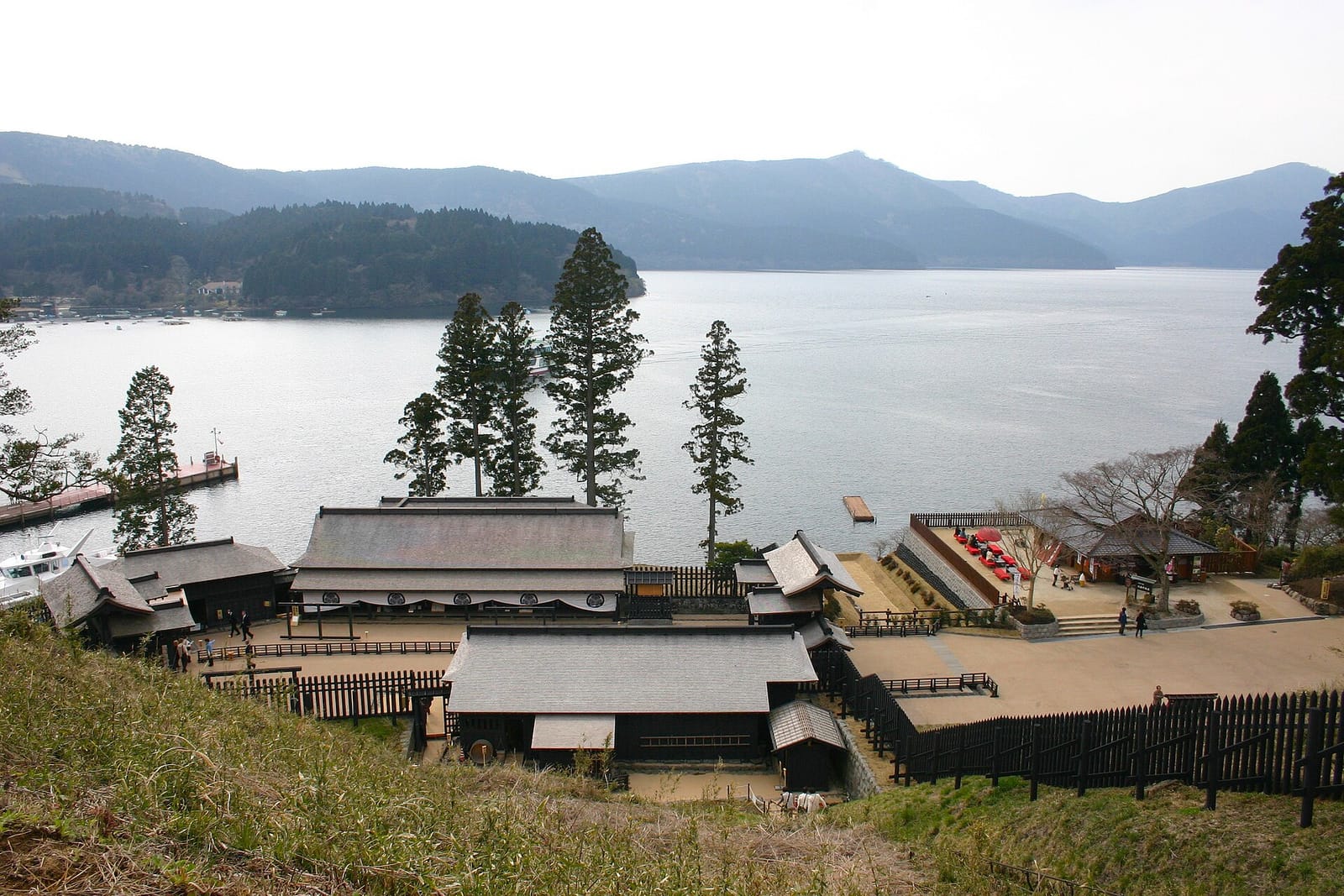
The rebuilt Edo-period checkpoint on the old Tokaido road. The Japan Tourism Agency’s database notes that the shrine’s priests resisted a plan to put a checkpoint near the shrine grounds, so it was built farther down the road. Show your Freepass at the window for the discount.
- Hours
- 9:00–17:00; 9:00–16:30 Dec–Feb; last entry 30 min before closing
- Price
- Adults ¥500 (¥400 with Hakone Freepass), children ¥250 (¥150) (as of November 2026)
- Access
- About 5 min walk from Hakone-machi Port; about 2 min from the Hakone Sekisho-ato bus stop
- Source
- www.hakonesekisyo.jp
Onshi Hakone Park
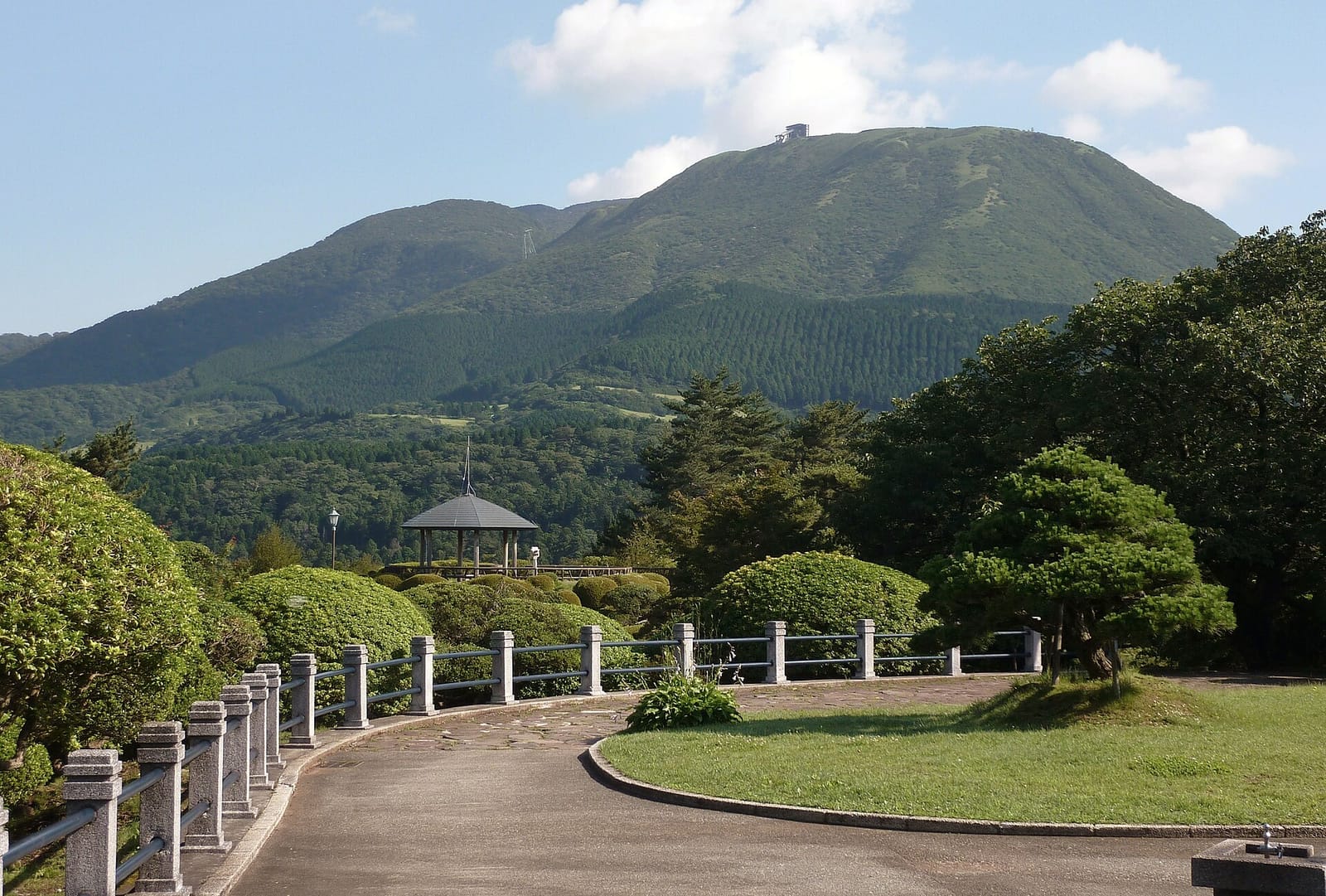
A lakeside park whose view of Mt. Fuji over Lake Ashi is one of Kanagawa’s 50 selected scenic views, according to the Kanagawa Tourism Association. The lakeside observation hall has a tea room on the second floor looking over the water. It sits between the checkpoint and the shrine, so it works as a break on the walk.
- Access
- Onshi-koen-mae bus stop, about 40 min by bus from Hakone-Yumoto Station
- Source
- kanagawa-kankou.or.jp
Peace Torii (Heiwa no Torii)
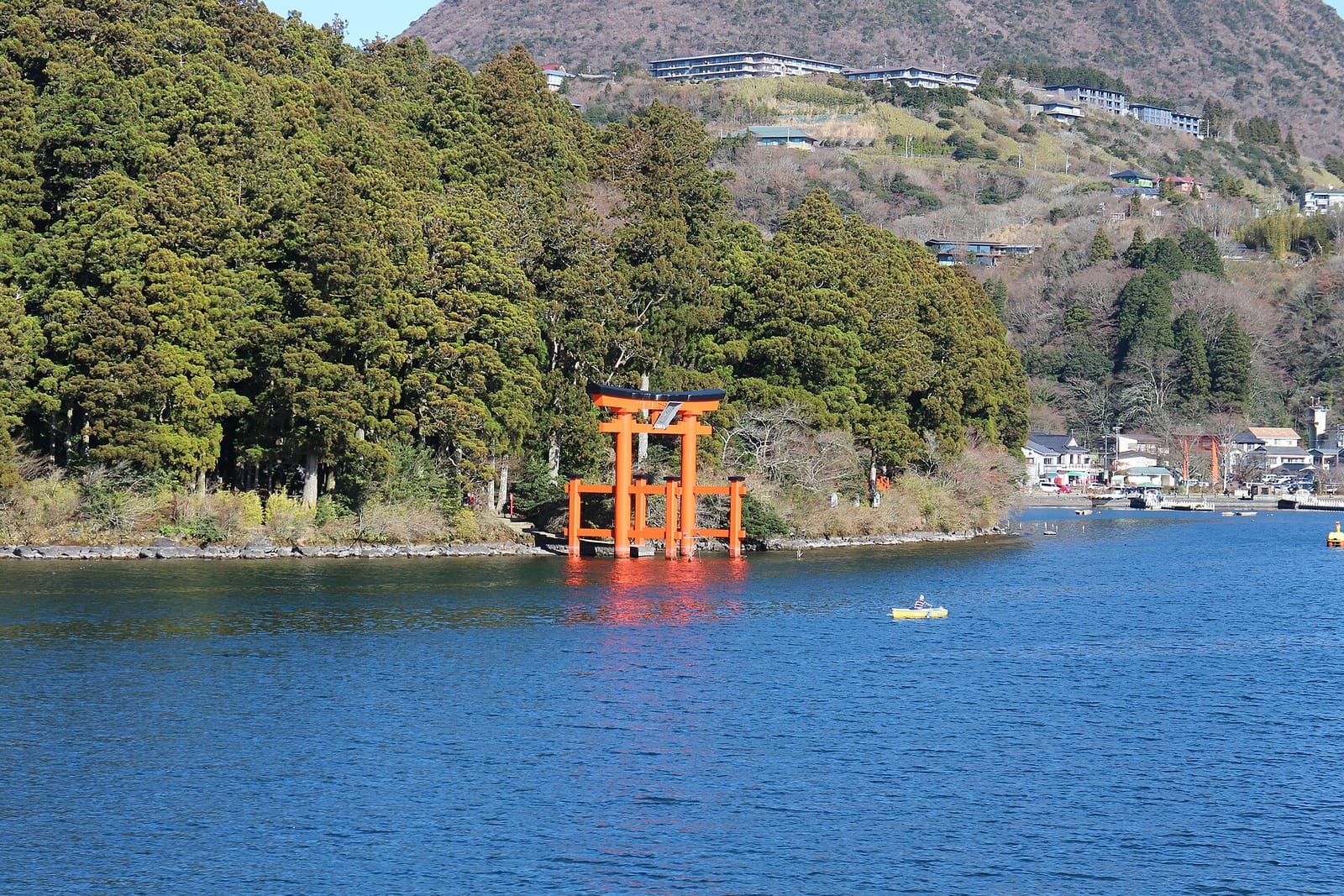
The red gate standing in Lake Ashi at the start of the shrine’s lakeside approach, built in 1952. Visitors take turns on the platform beneath it for photos; there is no official wait time. The Kanagawa Tourism Association notes that the torii and Mt. Fuji are reflected in the lake on clear days.
- Access
- About 10 min walk from Moto-Hakone Port
- Source
- hakonejinja.or.jp
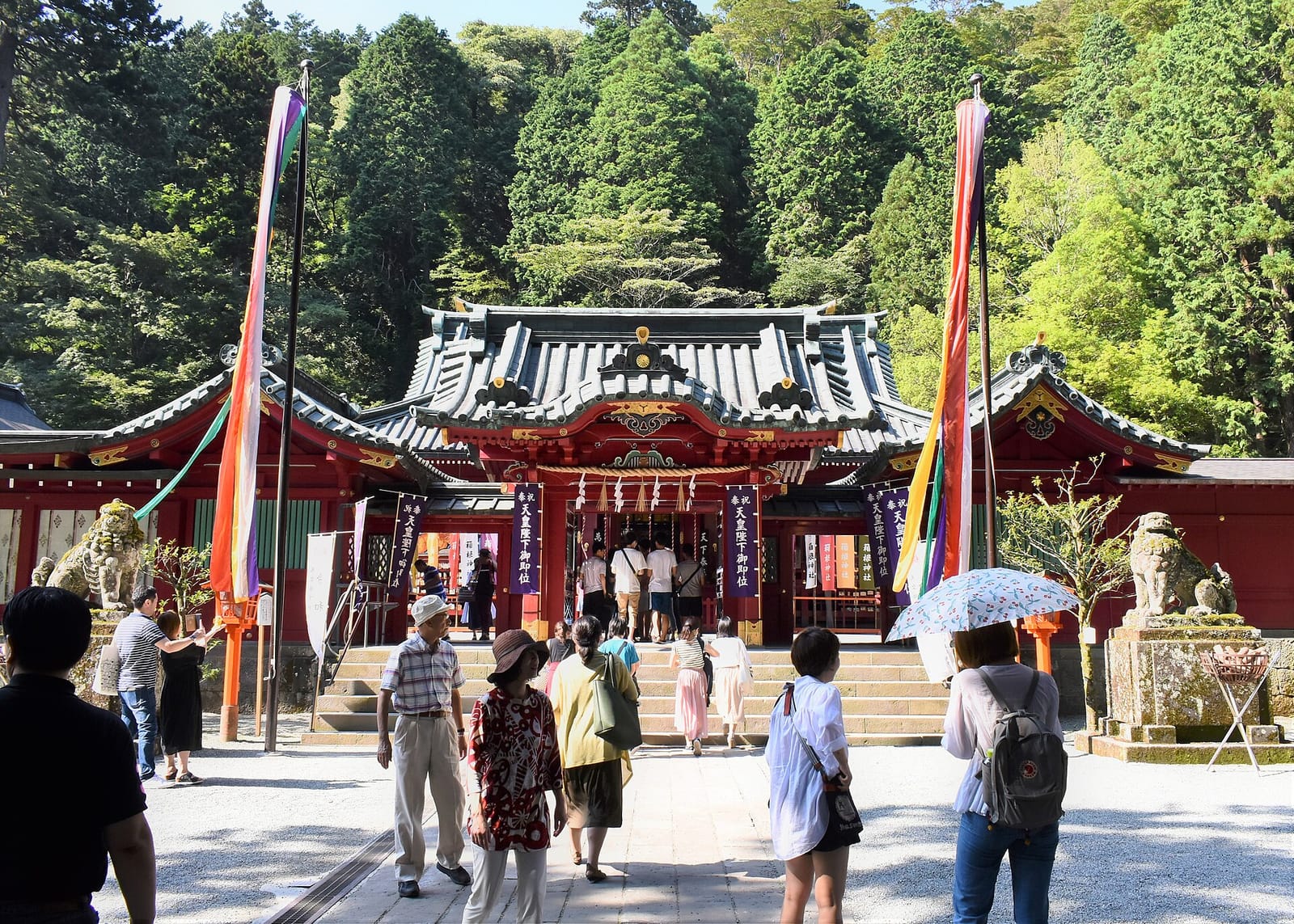
Hakone Shrine
The main hall is reached by about 90 stone steps lined with old cedars, or by a side path without steps. The Kanagawa Tourism Association lists a wheelchair-accessible route and toilets, and the shrine directs wheelchair users to the treasure hall elevator. The treasure hall may close briefly when exhibitions change.
- Hours
- Amulet office 8:15–17:00; prayers 8:30–16:00; treasure hall 9:00–16:00 (as of November 2026)
- Price
- Entry free; treasure hall ¥500 adults, ¥300 children (as of November 2026)
- Access
- About 10 min walk from Moto-Hakone-ko; Hakone Jinja-iriguchi bus stop is skipped 10:00–16:00
- Source
- kanagawa-kankou.or.jp
Kuzuryu Shrine Shinmiya
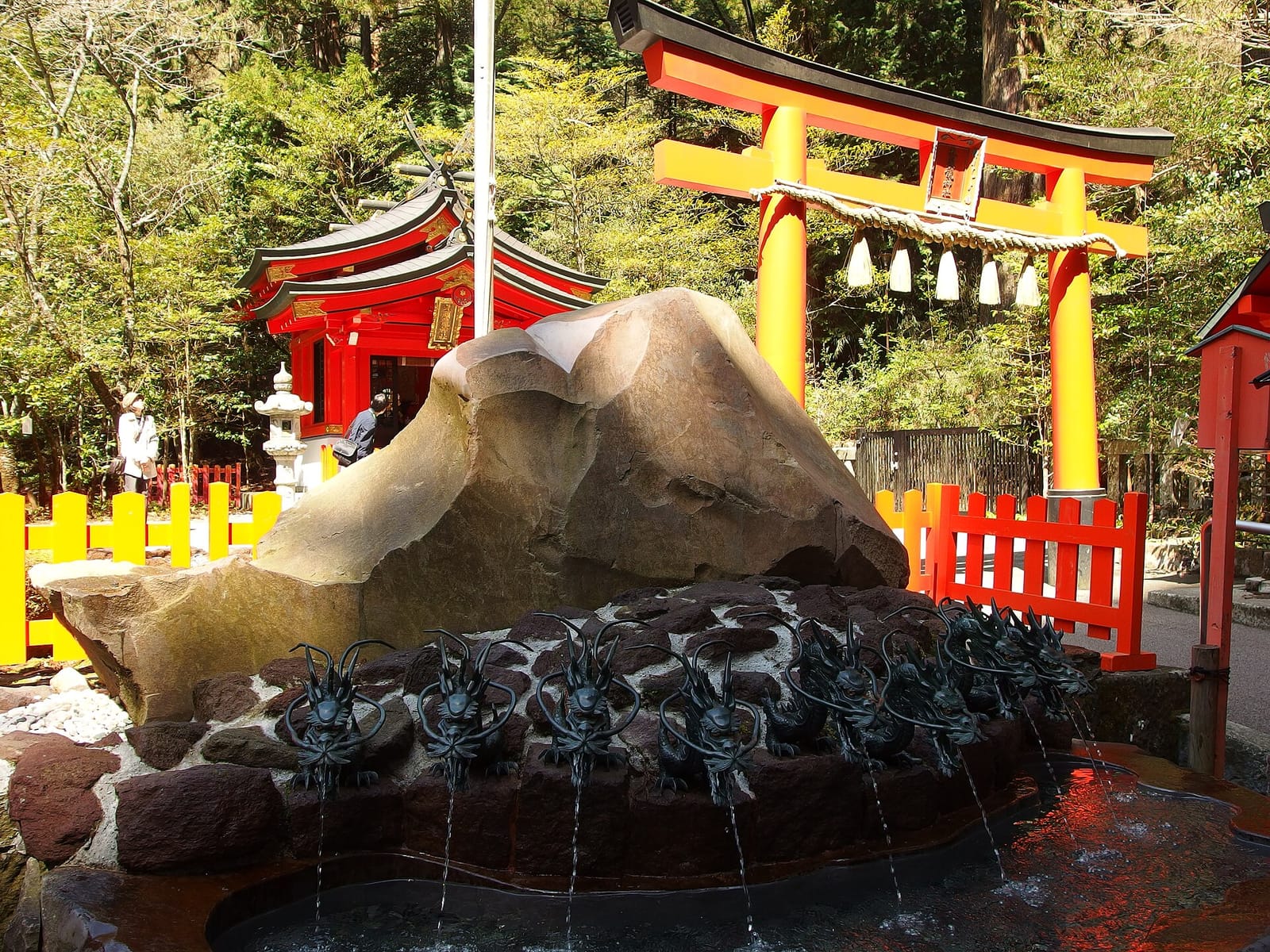
The branch of Kuzuryu Shrine inside the Hakone Shrine grounds, next to the main hall. Its worship hall was rebuilt in the shrine’s Reiwa commemorative project, and the ceiling has an ink painting of the nine-headed dragon that is said to protect Lake Ashi. It is the easy way to visit Kuzuryu if you do not have time for Hakone-en.
Kuzuryu Shrine Honmiya
The main sanctuary of Kuzuryu Shrine, in the forest on the lake shore beyond Hakone-en. The shrine says the Kuzuryu forest normally costs ¥600 to enter, and that on the monthly festival on the 13th it is free in the morning for worshippers (as of November 2026). Prince Hotels also runs a motorboat to the shrine from Hakone-en, 9:00–15:30 with last reception at 15:00.
- Access
- About 30 min walk from Hakone-en along the lakeside path (non-festival days)
- Source
- hakonejinja.or.jp
Hakone Komagatake Ropeway
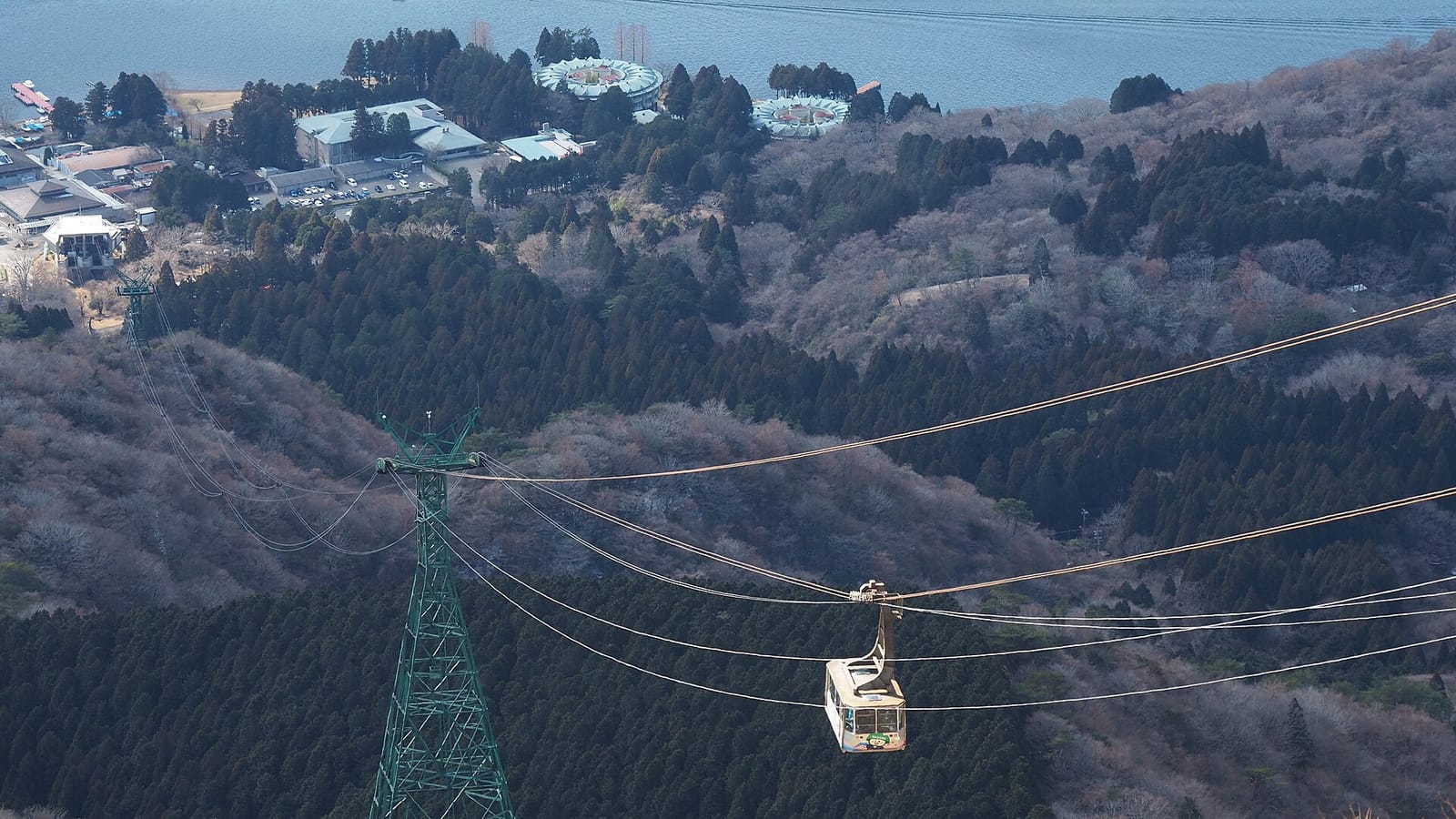
The ropeway from Hakone-en to the top of Mt. Komagatake, where Hakone Motomiya, the shrine’s inner sanctuary, is about 8 minutes on foot from the summit station. It stops in strong wind, so check the Prince Hotels status page on the day.
- Hours
- Last ascent 16:30, last descent 17:00; departures every 20 min from 9:00 (as of November 2026)
- Access
- Hakone-en, about 8 min to the summit station
- Source
- www.princehotels.co.jp
How do you get to Hakone Shrine from Shinjuku?
By train and bus, by highway bus, or by the ropeway-and-boat loop. The shrine’s access page lists the Odakyu Highway Bus from Shinjuku to Moto-Hakone; the Odakyu Line from Shinjuku to Hakone-Yumoto, then a Hakone Tozan Bus to Moto-Hakone; and the route over the mountain by Hakone Tozan Train, Hakone Ropeway and sightseeing boat. The Kanagawa Tourism Association gives about 60 minutes by bus from Odawara Station to the Moto-Hakone stops.
Remember the stop rule: between 10:00 and 16:00, ride to Moto-Hakone-ko, not Hakone Jinja-iriguchi. If you plan to ride several legs, our Hakone Freepass break-even guide works out whether the pass pays for itself, and the Hakone day trip from Shinjuku puts the shrine into a full loop.
 Hakone Stopover Between Tokyo and Kyoto with Luggage: 3 Bag Plans
 Hakone-Yumoto Street Food: What to Eat From 7:30 to 22:00
FAQ
How long is the wait for the Hakone Shrine torii photo?
There is no official figure. Neither Hakone Shrine nor the Kanagawa Tourism Association publishes a wait time for the Peace Torii photo spot, and it changes with the day, season and weather. Visitors take turns on the platform, so look at the length of the line when you arrive and decide whether to join it or take the photo from the shore.
What time does Hakone Shrine open?
The shrine lists its counter hours rather than gate hours: the amulet and goshuin office is open 8:15–17:00, prayer services run 8:30–16:00 and the treasure hall is open 9:00–16:00. It does not publish separate opening hours for the grounds. New Year hours change by day from January 1 to 5.
Is Hakone Shrine free to visit?
Yes. The Kanagawa Tourism Association lists shrine entry as free. The treasure hall costs ¥500 for adults and ¥300 for children, as of November 2026.
Can you see the Hakone Shrine torii from the pirate ship?
Yes. The torii stands in Lake Ashi near Moto-Hakone, and the sightseeing boats between Togendai, Hakone-machi and Moto-Hakone pass in view of it.
When is the Hakone Shrine torii closed?
The shrine closes the area around the Peace Torii for ceremonies. In 2026 it announced a closure on July 31 for a purification ceremony. Over New Year, the shrine restricts the approach when it is congested and runs a one-way route down. Check the notices on the official site before you go.
Sources
- Hakone Shrine (official site, Japanese) — hours and notices
- Hakone Shrine — Access (Japanese)
- Hakone Shrine — Grounds guide, Peace Torii (Japanese)
- Hakone Shrine — New Year visits (Japanese)
- Kanagawa Tourism Association — Hakone Shrine (Japanese)
- Japan Tourism Agency multilingual database — Hakone Shrine
- Kanagawa Tourism Association — Onshi Hakone Park (Japanese)
- Hakone Checkpoint (official site, Japanese)
- Prince Hotels — Hakone Komagatake Ropeway and Hakone-en operating status (Japanese)
This article contains affiliate links. We may earn a commission at no extra cost to you.