Hanazono Shrine Guide: Access, Shrine Office Hours and Events
Hanazono Shrine in Shinjuku for visitors: the exit to use, what to see on the grounds, shrine office hours, amulet prices, the Sunday market and event dates.
At Hanazono Shrine, the custom is to purify first and pray second: wash your hands and mouth at the temizuya basin, then walk up to the main hall. It is an easy rule to miss here, because the shrine sits between Isetan and the Golden Gai bar lanes and many people simply cut through. The shrine office stays open until 20:00 on most days, so even an evening visit leaves time to follow the steps and pick up an amulet. The 2026 Tori-no-Ichi fairs (November 6–7 and 18–19) are now over, and the next dates on the official calendar are December 31 and January 1. This guide walks the grounds in the order you meet them from the station, then continues to Golden Gai next door.
Why visit Hanazono Shrine, and why in this order?
Visit because it is the guardian shrine of all Shinjuku and sits between the department stores and the Golden Gai bar lanes, so it fits into almost any walk on the east side. The shrine says it was already the main guardian shrine of Shinjuku before Tokugawa Ieyasu founded his government in Edo in 1603, and that it moved to its present site in the Kan’ei era (1624–1644) from about 250 meters south, near today’s Isetan department store.
The order below follows the way the grounds open up from Shinjuku-sanchome Station: main hall first, then the two smaller shrines on the grounds, then out to the walking path and Golden Gai. Afternoon to early evening works best. The shrine office is open until 20:00 on most days, and GO TOKYO says most Golden Gai bars open around 20:00, so you can finish one and start the other.
| Stop | Time to allow | Best time |
|---|---|---|
| Main hall and great torii | 10–15 min | Any time the office is open, if you want an amulet |
| Geino Asama Shrine | 5 min | Daytime, to read the plaques |
| Itoku Inari Shrine | 5–10 min | Daytime, for light under the torii |
| Shiki no Michi | 5 min | Dusk |
| Golden Gai | 1 hour or more | From about 20:00 |
How do you get to Hanazono Shrine?
Take the subway to Shinjuku-sanchome Station and use Exit E2, which the shrine lists as 0 minutes away. The station is served by the Tokyo Metro Marunouchi and Fukutoshin lines and the Toei Shinjuku Line. If you arrive at the JR, Odakyu or Keio Shinjuku Station, use the East Exit; the shrine gives a 7-minute walk from there. Our Shinjuku Station exits guide shows how the East Exit connects to the streets around the station.
The shrine also lists two Toei bus stops 3 minutes away on foot: Shinjuku-sanchome (route Shina 97) and Shinjuku Isetan-mae (route Haya 77). The official address is 5-17-3 Shinjuku, Shinjuku-ku.
What should you see at Hanazono Shrine?
Start under the great torii and walk straight to the main hall, then turn to the two smaller shrines on the grounds. Each stop below can be added to a walking route.
Hanazono Shrine (main hall)
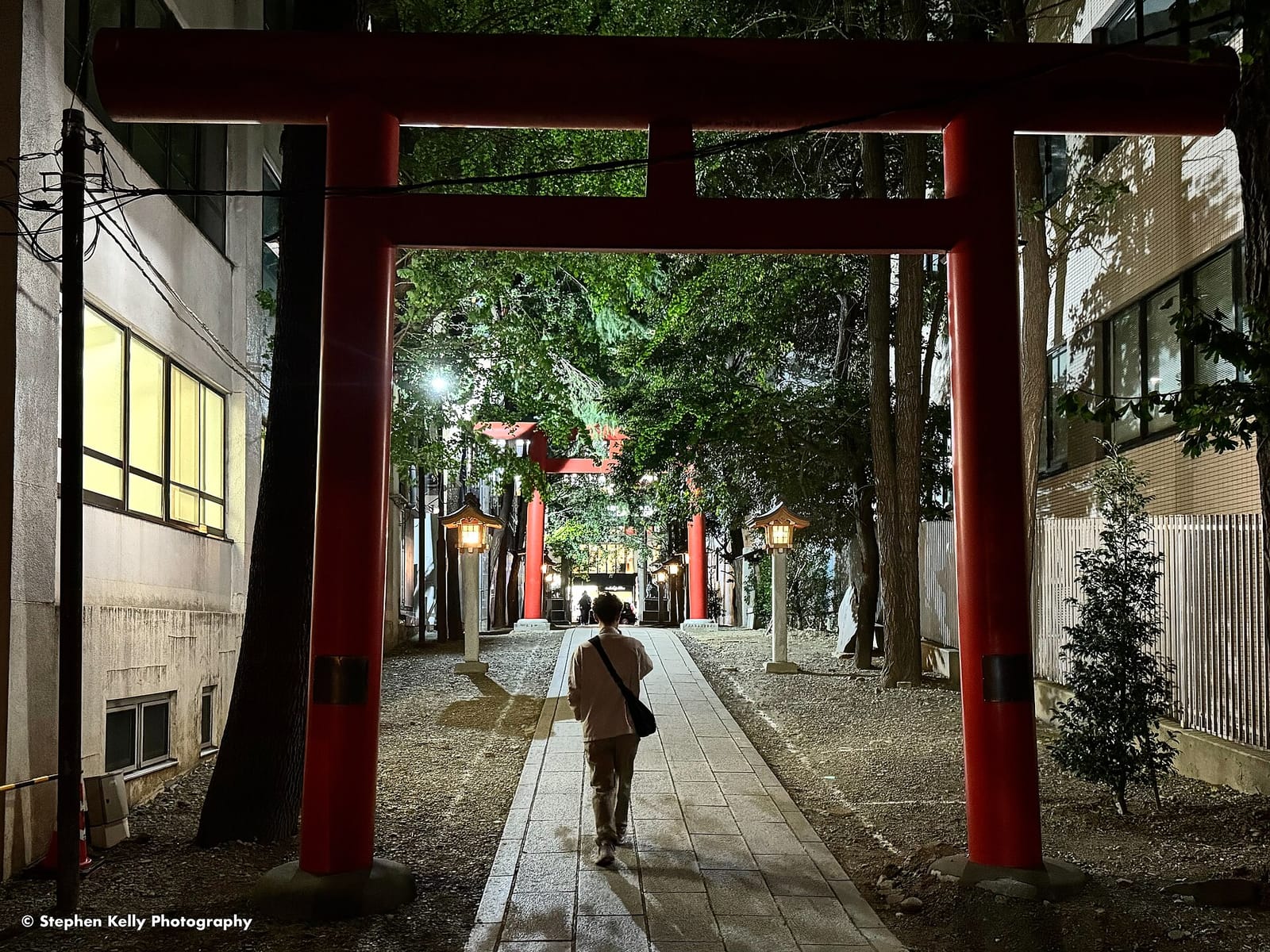
The steel great torii at the entrance was built in 1996, and the shrine calls it one of the tallest in Shinjuku. The present main hall and shrine office are reinforced concrete, completed in June 1965 after earlier buildings were lost to fires and the war. Near the hall stand a pair of bronze guardian lions cast in 1821 by the craftsman Murata Seimin, registered as a tangible cultural property of Shinjuku City. Wash your hands and mouth at the purification basin (temizuya) before you pray.
- Access
- Shinjuku-sanchome Station Exit E2, 0 min; 7 min on foot from the East Exit of Shinjuku Station
- Source
- hanazono-jinja.or.jp
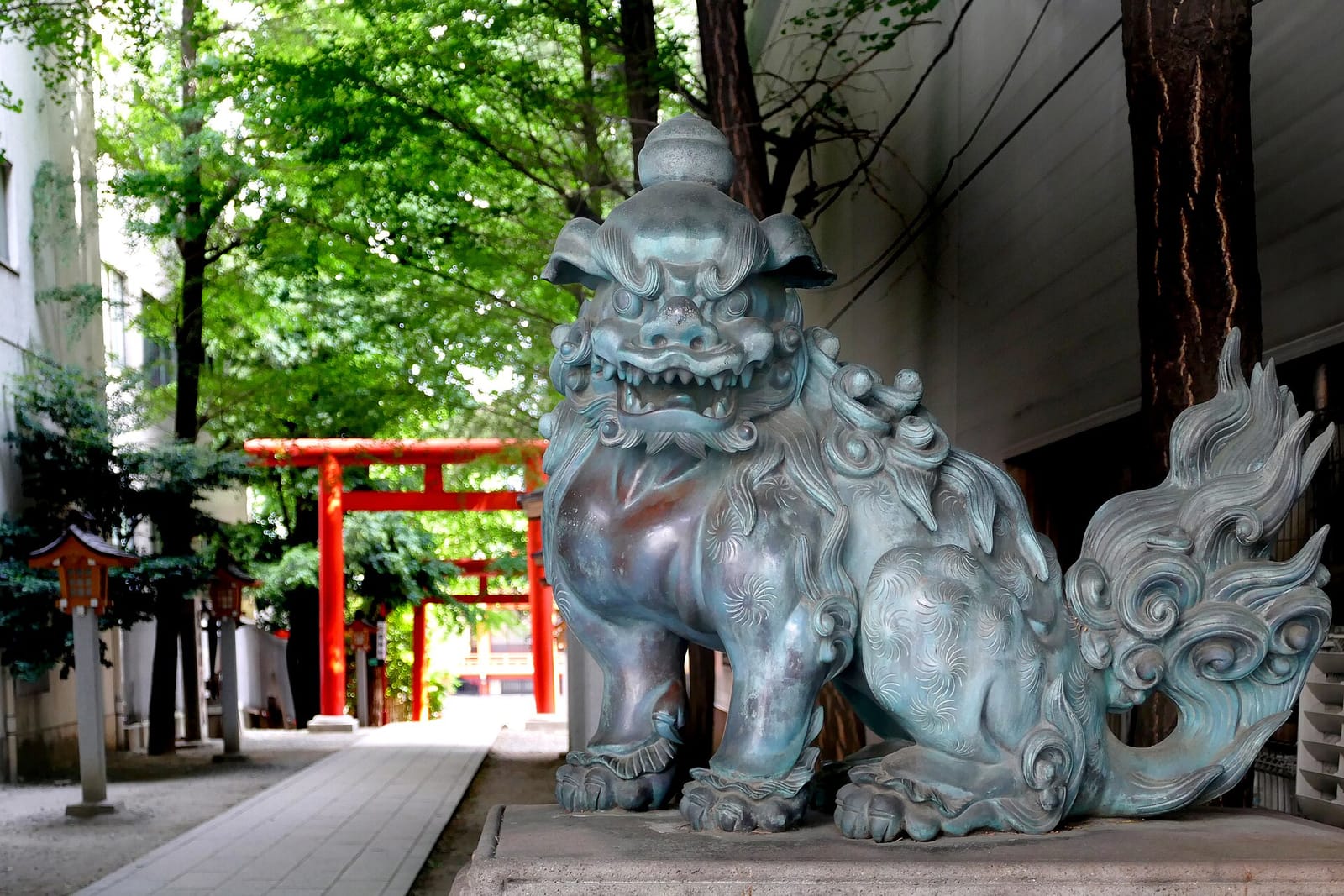
Geino Asama Shrine
This small shrine is dedicated to Konohanasakuya-hime and is known for offerings from people in theater, music and other performing arts. The shrine traces that link to the Edo period, when it raised money to rebuild after fires in 1780 and 1811 by holding plays and shows on its grounds; in the postwar years it hosted Kara Juro’s tent theater. Next to it stands a stone monument to the singer Fuji Keiko, mother of Utada Hikaru. Its “Geido Joju” amulet for success in the arts costs 1,000 yen (as of November 2026).
- Access
- On the grounds of Hanazono Shrine
- Source
- hanazono-jinja.or.jp
Itoku Inari Shrine
A short line of red torii gates donated by worshippers leads to this small shrine, said to have been built around April 1928. The shrine describes it as especially popular with women. The amulet for harmony between partners and family, sold at the shrine office as this shrine’s charm, costs 500 yen (as of November 2026). The torii line is narrow, so let people pass before you stop for a photo.
- Access
- On the grounds of Hanazono Shrine
- Source
- hanazono-jinja.or.jp
What does the shrine office sell, and when is it open?
The shrine office (shamusho) is open every day of the year, from 9:00 to 20:00, although the shrine notes it may close at 18:00 depending on conditions (as of November 2026). It handles amulets (omamori), talismans and prayer requests. Individual prayer services run 9:30–11:30 and 13:00–16:30, with an offering from 5,000 yen; the shrine asks you to call ahead even for a personal prayer.
A few amulet prices from the shrine’s list, as of November 2026:
| Amulet | Purpose | Price |
|---|---|---|
| Nishiki mamori | General health and family safety | 500 yen |
| En-musubi mamori | Finding a good partner | 500 yen |
| Kin-un mamori | Luck with money | 700 yen |
| Geido Joju mamori | Success in the performing arts | 1,000 yen |
| Kotsu Anzen mamori | Road safety | 300 yen (small) / 1,000 yen (large) |
The shrine advises keeping an amulet sealed and carrying it with you. If you have an old talisman to return, the box near the hall accepts only paper talismans and charms; the shrine says items from other shrines or temples cannot be left there, and lucky rakes (kumade) go to the shrine office instead.
When are the festivals and markets?
The big event is Tori-no-Ichi in November, and the regular one is the Sunday antique market. The shrine’s 2026 calendar lists these dates:
| Event | 2026 date |
|---|---|
| Setsubun | February 3 |
| Annual grand festival (portable shrines on the 24th) | May 22–25 |
| Bon odori dance | August 1–2 |
| Tori-no-Ichi (Otori-sai) | November 6–7 and 18–19 |
| Year-end purification | December 31 |
| Open-air antique market | Every Sunday, sunrise to sunset; cancelled on event days and in rain |
For Tori-no-Ichi 2026, stalls ran from about 15:00 to midnight on each eve (November 6 and 18) and from about noon to midnight on each main day (November 7 and 19). The shrine warned that entry to the grounds could be restricted when crowded after 18:00, and that goshuin were pre-written only on those days. If you are planning for November 2027, check the shrine’s news page; it posted the 2026 dates on October 7.

For other free stops on the same side of the station, our list of free things to do in Shinjuku puts the shrine on a route with the observatory and Omoide Yokocho.
Where should you go after the shrine?
Walk on to Shiki no Michi and into Golden Gai, which sit just beside the shrine on the Kabukicho side. Both are a few minutes on foot.
Shinjuku Promenade Park Shiki no Michi
This 260-meter tree-lined path follows the old track bed of a Toei tram line that closed in 1970, and Shinjuku City opened it as a walking park in 1974. It runs along the edge of Golden Gai, and smoking is not allowed on it.
- Access
- About 4 min from Exit B5 of Shinjuku-sanchome Station
- Source
- www.city.shinjuku.lg.jp
Shinjuku Golden Gai
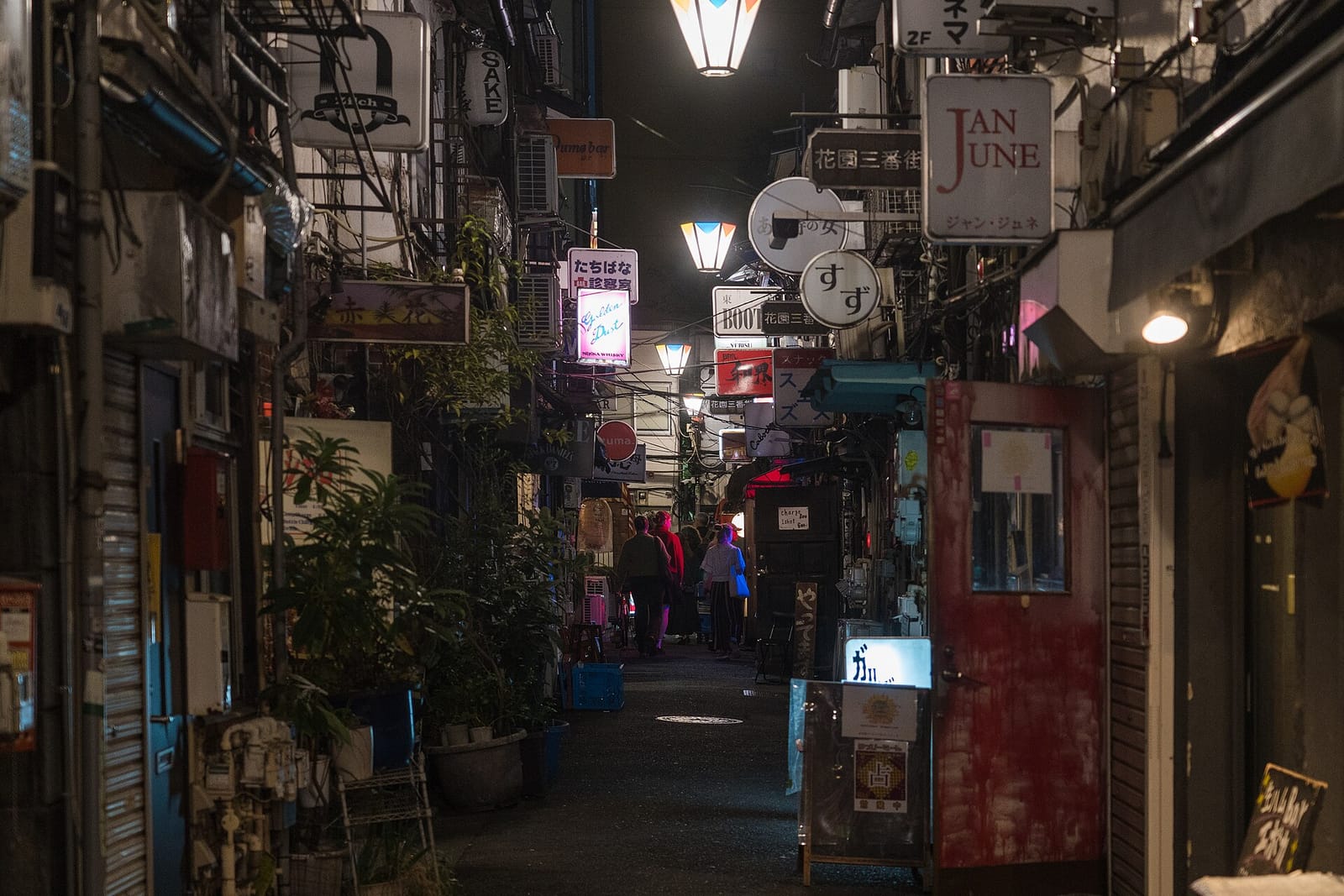
GO TOKYO counts around 280 tiny bars in a six-lane block, each with its own hours and charges, and some for members only. It also asks visitors not to smoke or drink in the street and not to take photos without permission. Our Golden Gai guide for first-timers explains seat charges and door signs.
- Hours
- Varies by bar; most open around 20:00 (as of November 2026)
- Access
- About 5 min on foot from the East Exit of Shinjuku Station
- Source
- www.gotokyo.org
Where can you stay near Hanazono Shrine?
If you want a hot spring bath after an evening on the east side, Onsen Ryokan Yuen Shinjuku is in the same Shinjuku 5-chome district as the shrine, on the Shinjuku Gyoen side.
Onsen Ryokan Yuen Shinjuku
This ryokan-style hotel at 5-3-18 Shinjuku has an open-air bath with hot spring water brought from Hakone, which the hotel describes as alkaline. Its restaurant, GOU Shinjuku, serves charcoal-grilled dishes, teppanyaki and sushi. Late check-in until 2:00 a.m. suits a night that ends in Golden Gai.
- Hours
- Check-in 15:00–26:00 (2:00 a.m.), check-out 11:00 (as of November 2026)
- Access
- 7 min on foot from Exit 3 of Shinjuku-gyoemmae Station; 8 min from Exit C7 of Shinjuku-sanchome Station
- Source
- uds-hotels.com
For more hotels with baths in the area, see our list of Shinjuku hotels with a large public bath, or compare districts in where to stay in Shinjuku for first-timers.
How do you make the most of the visit?
Keep it short, quiet and in order: pray at the main hall first, then visit the smaller shrines, then leave for the bars. A few practical points:
- Bow and pray at the main hall first. A simple sequence is to wash at the temizuya, offer a coin, bow twice, clap twice, and bow once more.
- Come in the day for the side shrines. The torii line at Itoku Inari is easiest to see in daylight, and prayer services stop at 16:30.
- Check the date before a Sunday visit. The antique market is cancelled on event days and in rain, so a wet Sunday means an empty courtyard.
- Avoid fair evenings with luggage or a stroller. On Tori-no-Ichi days, the shrine may restrict entry after 18:00.
- Finish your drink before you enter. The shrine is a place of worship, even though it sits right next to a bar district.
Tick “Add to my route” on the stops above, and the box at the end of the page opens them in Google Maps as one walking route, from the main hall to Golden Gai and on to the ryokan.
 Shinjuku Hotels With Big Rooms for Families: 6 Picks by Group Size
 Shinjuku Hotels Connected to the Station: What 'Direct' Means
FAQ
How do you get to Hanazono Shrine?
The closest exit is E2 of Shinjuku-sanchome Station (Tokyo Metro Marunouchi and Fukutoshin lines, Toei Shinjuku Line), which the shrine lists as 0 minutes away. From the East Exit of JR, Odakyu or Keio Shinjuku Station, the shrine gives a 7-minute walk.
What are Hanazono Shrine's opening hours?
The shrine office (shamusho), where amulets and prayer services are handled, is open every day from 9:00 to 20:00, though it may close at 18:00 depending on conditions, as of November 2026. Prayer services inside the hall are held 9:30–11:30 and 13:00–16:30.
When is the Tori-no-Ichi fair at Hanazono Shrine in 2026?
In 2026 the shrine held its Tori-no-Ichi (Otori-sai) fairs on November 6–7 and November 18–19, with about 260 stalls. Both have now finished; check the shrine's news page for the 2027 dates, which usually appear in October.
Is there a flea market at Hanazono Shrine?
Yes. The shrine's calendar lists an open-air antique market every Sunday from sunrise to sunset. It is cancelled on days with shrine events and when it rains.
Can you get a goshuin at Hanazono Shrine?
Goshuin are handled at the shrine office. During the Tori-no-Ichi fair days, the shrine hands out only pre-written goshuin rather than writing them in your book.
Sources
- Hanazono Shrine (official site, Japanese) — Access
- Hanazono Shrine (official site, Japanese) — Annual events 2026
- Hanazono Shrine (official site, Japanese) — Tori-no-Ichi 2026
- Hanazono Shrine (official site, Japanese) — Prayer services and office hours
- Hanazono Shrine (official site, Japanese) — Guide to the grounds
- Hanazono Shrine (official site, Japanese) — Origins and history
- Hanazono Shrine (official site, Japanese) — Hanazono Shrine and Shinjuku
- Hanazono Shrine (official site, Japanese) — Amulets and talismans
- Shinjuku City — Shinjuku Promenade Park Shiki no Michi (Japanese)
- GO TOKYO — Shinjuku Golden Gai
- Onsen Ryokan Yuen Shinjuku (official site)
This article contains affiliate links. We may earn a commission at no extra cost to you.