Japan Plug Type and Travel Adapter: What You Actually Need
Japan uses Type A sockets with two flat holes and 100 V power. Which adapter you need, when a converter matters, and where to buy one near Tokyo Station.
The most common power mistake in Japan happens on the first night. You land, check in near Tokyo Station, and find that your “universal” adapter has the right shape but your hair straightener runs weakly, or that your laptop’s three-pin plug will not go into the wall at all. Japan’s sockets and voltage are simple once you know two facts: the socket is Type A with two flat holes, and the power is 100 V everywhere. This guide covers the three mistakes that catch first-time visitors, the steps to get it right, and where to buy an adapter around Tokyo Station if you arrive without one.
What plug type and voltage does Japan use?
Japan uses Type A sockets, with two flat holes, and 100 V AC power. GO TOKYO, Tokyo’s official travel guide, describes the socket as “type A, with two flat holes”. JNTO, Japan’s national tourism organization, says the voltage is uniformly 100 V across the whole country.
The frequency is the only thing that changes by region:
- Eastern Japan, including Tokyo: 50 Hz.
- Western Japan, including Nagoya, Kyoto and Osaka: 60 Hz, according to JNTO.
Panasonic explains that the split goes back to the Meiji era, when a Tokyo power company bought 50 Hz generators from Germany and an Osaka power company bought 60 Hz generators from the United States. The two regions have kept those frequencies ever since.
For most travelers, the frequency is not a problem. Phone, tablet and laptop chargers are usually marked “50/60 Hz”, which means they work in both halves of the country.
What are the three most common plug mistakes in Japan?
The three mistakes are buying the wrong direction of adapter, assuming an adapter changes the voltage, and forgetting that a two-hole socket has no place for a third pin. Each one is easy to avoid if you check before you leave home.
Mistake 1: Buying an adapter made for Japanese travelers going abroad
Japanese shops sell two kinds of conversion plug, and they look similar on the shelf. One kind takes a Japanese Type A plug and lets it fit sockets in other countries. That is the wrong one for you. You need the other kind: an adapter with a Type A plug on the back that goes into the Japanese wall, and a socket on the front that accepts your home plug.
When you shop in Japan, look for packaging that says the adapter is for using overseas appliances in Japan. In Japanese, this is often written as 国内用 (for domestic use) or 海外製品を日本で使う (use overseas products in Japan). Products labeled 海外用 (for use overseas) are the reverse type.
Mistake 2: Thinking an adapter changes the voltage
A plug adapter changes the shape of the plug, nothing more. The electricity coming out is still 100 V.
JNTO notes that dual-voltage hair dryers, travel irons and shavers should work anywhere in Japan. Anything that is not dual-voltage needs a step-down transformer to convert the voltage. If you plug a 220–240 V-only hair dryer into a simple adapter in Japan, it receives less than half the voltage it was designed for. It may run slowly, heat poorly or not work at all.
Mistake 3: Bringing a plug with a third pin
Japanese wall sockets described by GO TOKYO have two flat holes. A plug with a third grounding pin, which many laptop power cables and some North American appliances have, may not fit into them.
If your laptop cable has a third pin, the simplest fix is to bring a charger that uses a two-pin cable, or an adapter that accepts your three-pin plug and has two flat pins on the Japanese side. Do not bend or remove pins from a plug.
How do you get the right adapter, step by step?
Read the label on each device first, then choose the adapter shape for your home plug, then decide whether anything needs a transformer. The whole check takes a few minutes at home and saves a shopping trip on your first evening.
- Find the input rating on every charger and appliance. It is printed on the charger brick, the plug or a sticker on the device. Look for a line like “INPUT: 100–240V ~ 50/60Hz”.
- Sort your devices into two groups. Anything that includes 100 V in its range (for example “100–240V”) works in Japan with an adapter only. Anything marked only “220–240V” or “230V” needs a step-down transformer, or should stay at home.
- Check the shape of your home plug.
- Two flat parallel pins (the North American shape): fits a Japanese socket as it is, as long as there is no third pin.
- Two round pins (most of continental Europe and much of Asia): needs an adapter.
- Three rectangular pins (the UK, Hong Kong, Singapore, Malaysia): needs an adapter.
- Two angled flat pins (Australia and New Zealand): needs an adapter.
- Count your devices. A phone, a watch, earbuds and a camera can quickly outnumber the sockets next to a hotel bed. One adapter that holds a multi-port USB charger often covers everything.
- Pack the adapter in your carry-on. If your checked bag is delayed, you can still charge your phone on the train from the airport.
If you are coming from Narita, the train ride into Tokyo is a good time to check your battery level. See how to get from Narita Airport to Shinjuku for the main routes.
Can you buy a plug adapter after you arrive?
Yes. JNTO says conversion plugs and transformers are relatively easy to find in urban areas. It names the Akihabara electronics district in Tokyo, Nipponbashi in Osaka, and large home-appliance retailers such as Yodobashi Camera and Bic Camera.
If you are staying around Tokyo Station, two options are close by. They are listed in order from the station, so you can tick “Add to my route” on each and open them in Google Maps at the end of the page.
Bic Camera Yurakucho
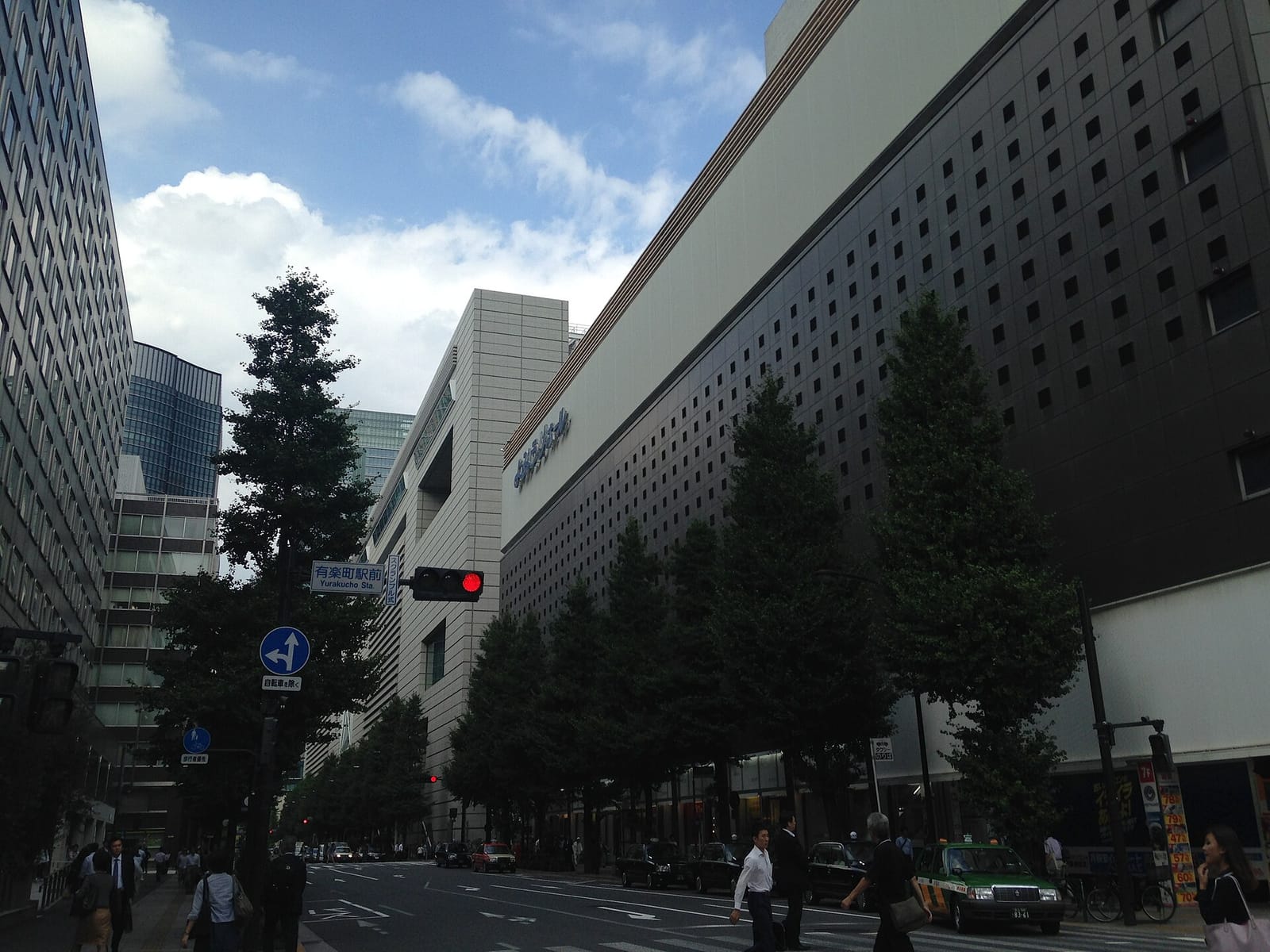
Bic Camera’s flagship store opened in June 2001 at 1-11-1 Yurakucho and sits right in front of the Hibiya Exit of Yurakucho Station, according to Chiyoda City’s tourism site. Yurakucho is one stop south of Tokyo Station on the JR Yamanote Line. The same page lists the store as open every day; check the store’s own site for current opening hours before you go.
- Access
- JR Yamanote Line, JR Keihin-Tohoku Line and Tokyo Metro Yurakucho Line, Yurakucho Station, 1 min walk
- Source
- visit-chiyoda.tokyo
Akihabara Electric Town
JNTO points visitors to Akihabara as one of the places where conversion plugs and transformers are easy to find. Akihabara is two stops north of Tokyo Station on the JR Yamanote Line or the JR Keihin-Tohoku Line. The district has many electronics shops, including large stores, so it is a good option if you also need a transformer or a spare charger.
When you shop, bring the device or charger you need to plug in. Staff can then check the shape and the voltage rating against the adapter on the shelf.
Which adapter should you buy before you fly?
A universal adapter with Type A pins covers Japan and most other trips. It changes the plug shape only; it does not change the voltage. If your plugs already have two flat parallel pins, you do not need one.
An adapter with swappable pins that the listing says include Type A, plus USB ports for charging phones at the same time. Check that your home plug fits the socket side before you order.
If you forget it, buy one in person at the stores above.
Where can you charge your devices while traveling in Japan?
Your hotel room is the main place, but there are outlets on many trains and in some restaurants too. The table sums up where to look and what to check.
| Where | What to know | Source |
|---|---|---|
| Hotel room | 100 V Type A sockets, two flat holes. Bring your adapter, or ask the front desk whether it has one to lend; this varies by hotel. | GO TOKYO, JNTO |
| Shinkansen | Newer shinkansen models have outlets next to the window seats. Ask for a window seat when you buy your ticket. | JNTO |
| Burger chains and family restaurants | Some have outlets available for customers. | JNTO |
| Electronics stores | Bic Camera, Yodobashi Camera and the Akihabara district sell conversion plugs and transformers. | JNTO |
If you are taking the shinkansen west from Tokyo, see how to get from Shinjuku to Kyoto by shinkansen for tickets and seats. Kyoto and Osaka are on 60 Hz, but chargers marked 50/60 Hz work the same there.
What else should you check before you plug in?
Check how much power the appliance draws, and avoid running several heating appliances from one adapter. Hair dryers, straighteners and kettles draw much more power than chargers, so plug them straight into the wall through a single adapter rather than through a multi-socket strip.
A few other points help on the day:
- Keep chargers dual-voltage. If you are buying a new charger before the trip, choose one marked 100–240 V. It will work in Japan with a plug adapter alone.
- Pack your power bank in your carry-on. Since April 2026, flights in Japan allow two power banks per person and no charging on board. See the airline rules for power banks in Japan.
- Label your adapters. If you travel with family, a simple sticker on each adapter makes it easier to pack everything again at checkout.
- Plan your cash and cards too. Electronics stores accept cards, but having some yen helps for small purchases. See currency exchange in Shinjuku for how to compare rates.
- Keep your receipts. If you buy a transformer or other electronics, the tax-free shopping guide explains how the refund system works since November 1, 2026.
With the right adapter in your carry-on and a quick look at each device label, the 100 V Type A sockets in Japan should not slow you down.
 Imperial Palace East Gardens and Marunouchi With Elderly Parents
 Tokyo Station to Narita by Bus: The ¥1,500 TYO-NRT From Yaesu
FAQ
What plug type does Japan use?
Japan uses Type A sockets, which have two flat holes, according to GO TOKYO, the official Tokyo travel guide. A plug with two flat parallel pins fits directly. Plugs with round pins, three rectangular pins or angled flat pins need an adapter.
Do I need a voltage converter in Japan?
Only for appliances that are not rated for 100 V. JNTO says the voltage throughout Japan is 100 V AC and that appliances that are not dual-voltage need a step-down transformer. Most phone and laptop chargers marked 100–240 V work with a plug adapter alone.
Will my hair dryer work in Japan?
A dual-voltage hair dryer should work anywhere in Japan, according to JNTO. A dryer rated only for 220–240 V will not run properly on 100 V without a transformer, so check the rating on the dryer or its plug before you pack it.
Is Tokyo 50 Hz or 60 Hz?
Tokyo is on 50 Hz. JNTO says eastern Japan uses 50 Hz and western Japan, including Nagoya, Kyoto and Osaka, uses 60 Hz. Chargers marked 50/60 Hz work on both, so the change only matters if you travel west with a device rated for one frequency.
Where can I buy a plug adapter near Tokyo Station?
JNTO names large home-appliance retailers such as Bic Camera and Yodobashi Camera, plus the Akihabara electronics district. Bic Camera Yurakucho is a 1-minute walk from Yurakucho Station, one stop south of Tokyo Station on the Yamanote Line.
Sources
This article contains affiliate links. We may earn a commission at no extra cost to you.